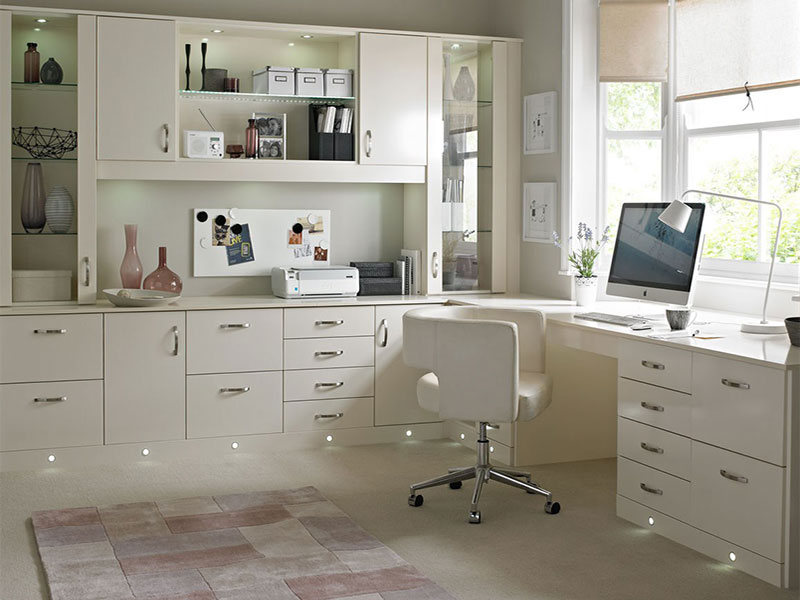
Custom home office storage cabinets only boost productivity if what’s inside them is organized, the finest built-in in Toronto still fails if the stapler lives in four places and the cables run wild. Space Age Closets has designed home office cabinetry across Toronto and the GTA for decades, and the systems that stay tidy years later all follow the same handful of management rules: everything has one home, the busiest items sit closest to the chair, and paper and power are given routes of their own. Here’s how we set up the inside of an office cabinet system.

Keep High-Use Items Within Arm’s Reach
The first rule of cabinet management is frequency: whatever you touch most during the workday belongs in the drawer or shelf you can reach without leaving the chair. A visual artist or architect wants sketching and drafting materials in the nearest drawers; a laptop-based worker wants a dedicated slot where the machine lands every evening. When your cabinets were designed around how you actually work, this zone already exists, your job is to defend it. If something you haven’t used in a month is living in prime desk-side real estate, demote it and promote what you reach for daily.
Give Every Category One Home
Supplies scatter because they’re allowed to live anywhere. Assign one drawer or shelf per category, writing tools, paper stock, tech accessories, shipping bits, and be strict about it. The payoff is twofold: you always know where things are, and you can see at a glance when you’re genuinely low instead of discovering three opened boxes of the same pens. One shelf as the designated “inventory zone” for backup supplies turns restocking into a ten-second visual check.
Active Paper in Front, Archives Up High
Paper needs a flow, not just a place. Files you’re working this month belong in the file drawers nearest the desk; completed work moves back to closed cabinets or the upper sections you need a reason to open. When a project wraps, move its folder out of the active drawer the same week, an active drawer that only holds active work is what keeps the desktop from becoming the filing system. Incoming mail gets one tray inside the cabinet run, emptied on a schedule, so it never colonizes the work surface.
Tame the Cables and Controls
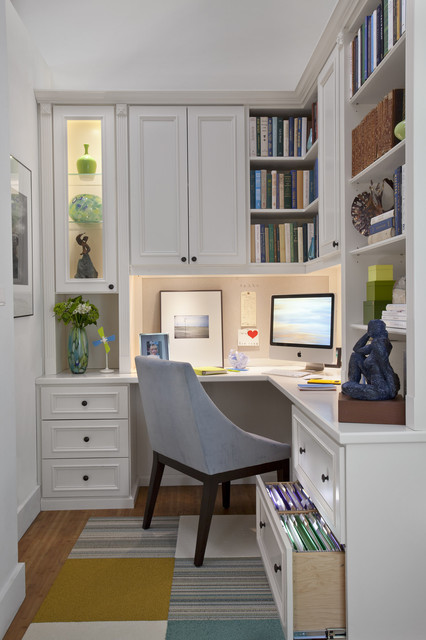
Distraction management is cabinet management too. Switches, controls, and power cords should be reachable, not trapped behind cabinetry, you’ll want to kill the speakers, dim the lights, or swap screens without crawling under the desk. Compact cabinet runs help here because you can reach around them easily. Inside the cabinets, give charging its own drawer or cubby so phones and tablets top up out of sight, and route cords through the back of the cabinetry instead of across it. When the wiring has a home, the desk stops looking like the junction box.
Choose Surfaces You Can Wipe in Seconds
Office cabinets see coffee rings, ink, and crumbs, that’s life at a desk. Materials that wipe clean in one pass keep a two-minute mess from becoming a Saturday chore, which is why we steer clients toward easy-clean finishes on work surfaces when the cabinetry is designed. Pair that with a five-minute end-of-day reset, papers into the active drawer, devices onto the charging shelf, mugs out, and the office opens clean every morning. Our custom home office cabinets in Toronto are designed around exactly these habits, so the organization is built into the millwork instead of bolted on afterward.

Office Cabinet Organization Questions, Answered
What belongs in the cabinet space closest to my desk?
Only what you touch daily: the current project files, everyday writing tools, the laptop’s landing spot, and the notepad you actually use. Everything else, backup supplies, finished work, reference material, earns a home one step further away. If you audit that zone every month or two, the whole system stays honest.
Where should active files live versus archived paperwork?
Active files go in the drawer bank beside the chair; archives go into closed cabinets or the upper sections you have to reach for. The physical separation is the system, when finished work is moved back the week it wraps, the active drawer stays thin and finding anything takes seconds.
Can a cabinet drawer double as a charging station?
Yes, a charging drawer or cubby is one of the most-requested features in our office builds. Power is routed into the cabinetry at design time, so phones and tablets charge behind a closed front instead of on the desk. Devices out of sight is good for the room’s look and better for your focus.
How do I organize office supplies so I stop buying duplicates?
One category, one home, and one visible inventory shelf for the backups. Duplicates happen when supplies hide in several spots and you shop from memory. When every opened box lives in a single assigned place, a glance before ordering replaces the guesswork, and the fourth box of staples stops arriving.
What’s the best way to keep incoming mail and paperwork off the desk?
Give it a single entry point: one tray inside the cabinet run where every new piece of paper lands, cleared on a set rhythm, file it, act on it, or recycle it. The desk stays a work surface because paper never gets to camp there; it’s either in the inbox tray or in a drawer.
Ready for an office where the organization is built into the cabinetry? Call Space Age Closets at (647) 394-7557 to book a free in-home design consultation.